

A clear explanation on the differences betweeed 6DoF and 3DoF tracking
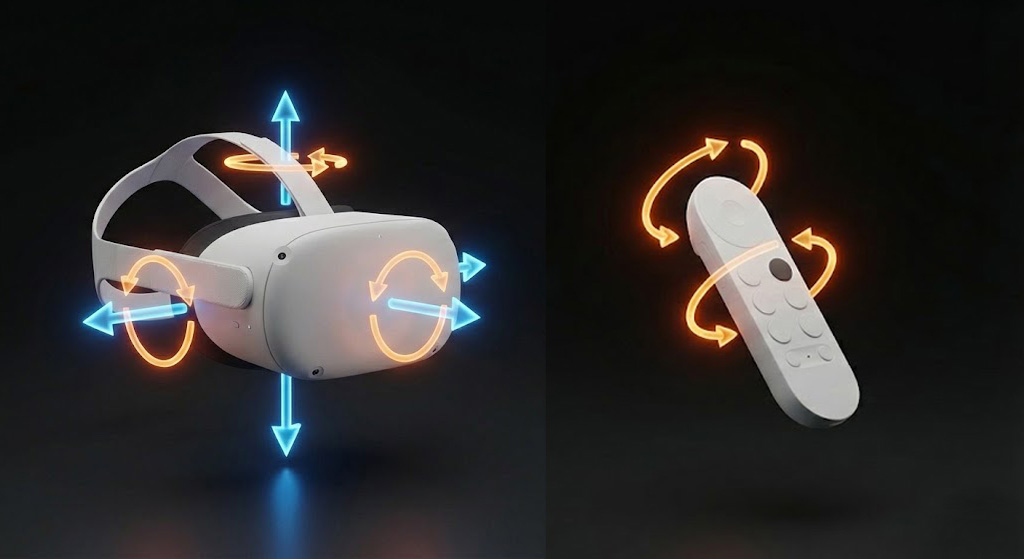
6DoF and 3DoF stand for six-degrees-of-freedom and three-degrees-of-freedom. 6DoF Tracks both rotation and position, so a device knows where it is and how it is moving through space. 3DoF only measures orientation, allowing a device to know the direction it is facing but not its movement through space.
Degrees of freedom describe how a system measures motion. 3DoF tracks rotation around three axes: pitch, yaw and roll. This is often used for seated or fixed position experiences and is measured using IMU sensors (gyroscope, accelerometer and a magnetometer). Game controllers like the original Wii controller, some smart TV remotes, and early VR headsets used this approach.
6DoF adds positional tracking. In addition to rotation, the device tracks translation along three axes: X, Y, and Z. This allows the device to know precise movements as a user walks, sits, or runs through a room by using an IMU along with cameras for spatial tracking. Devices like the Apple Vision Pro, Meta Quest and many AR headsets use 6DoF tracking methods as a key ingredient for spatial understanding for both headset and their controllers.
Most 6DoF systems rely on a combination of inside-out cameras, SLAM, World tracking, accelerometers, gyroscopes and sometimes LiDAR or other depth sensors. They recognize feature points in the environment from frame to frame and compare them as you move. This creates a precise map of your motion and position within a space.
A person may wonder why 3DoF isn't enough for augmented reality, and the reason is that AR depends heavily on spatial alignment and adding 3D models to a space . Without positional tracking, virtual content can’t stay aligned to the world.
6DoF technology makes spatial computing possible. It enables persistent anchoring, accurate occlusion, and stable virtual content. AR content can stay in the same position as a person moves around it. This is necessary for many key use cases in AR, including training, simulation, navigation, and 1:1 scale visualizations.
3DoF tracking can be useful but only in situations where the user does not need to move freely. It is suitable for lighter weight HUD-style overlays like simple media playback and directional controllers. Lightweight AI glasses often rely on 3DoF tracking because they prioritize a minimal form factor and battery life over spatial precision.
In order to build accurate interfaces, designers must know the capabilities of a headset and its controlling input.
In 6DoF systems, users can move around the space freely and view AR content from any angle. Because of this, interfaces must take into account user depth, position and distance. Content should appear at natural heights in the room and integrate thoughtfully with surfaces in your environment.
In 3DoF systems, digital content should remain more simple and fixed. UI panels should appear within a consistent viewing area in the user's field of view and buttons should be larger and more forgiving since inputs are not as precise.
True AR experiences require 6DoF motion which is possible for iOS and Android mobile devices as well as most AR headsets. All content built within Trace will leverage the tracking and spatial benefits of 6DoF devices.
• 6DoF: Apple Vision Pro knows your position in the room so objects stay anchored as you walk.
• 6DoF: Meta Quest controllers track their spatial position so a user can reach out and turn a virtual knob as if it were physically there.
• 3DoF: Early VR headsets like the initial Oculus Development Kits where the user could rotate their head but not walk through the space.
• 6DoF does not guarantee perfect tracking. Tracking uses a device’s camera and still depends on lighting and visual features.
• AR glasses are not always 6DoF. Many low profile devices use 3DoF for portability.
• 3DoF technology is not necessarily worse. It allows for smaller devices without cameras for simpler, low-power experiences.
6DoF and 3DoF define how your device understands motion. Each has their pros and cons, though for augmented reality experiences 6DoF tracking is a must for spatially anchored and immersive experiences.
Learn about augmented reality or start creating your own experiences.